The guidebook that we are following for the TA route has segments divided by possible places to stay and also offering services like stores and cafes. Most days we’ve simply ridden one segment. In the last few days we’ve done two segments which has worked pretty well.

Day 1: Tapawera to Murchison, though Rotoroa Lake: 58 miles and 3500 feet of elevation gain.
Day 2: Murchison to Reefton through Springs Junction, 75 miles and 5600 feet of elevation gain.
Each segment we’ve done has been a mixture of paved road and gravel, which has added both to the interest and difficulty. Rougher gravel roads are generally more rural and less trafficked, but easier to traverse if we deflate our tires to about 20 PSI to roll more easily over rougher terrain. Smooth roads are faster with tire pressures more like 50 PSI, meaning that we need to pump about 150 strokes of our mini pump into each tire to make the transition. In practice, we ride sometimes with lower pressures than optimal, since it’s kind of a pain in the butt to pump up tires for such short distances. Small details, but it makes a difference!
Tapawera to Murchison was a day of weather contrasts. Temperatures at noon were almost 90 degrees (30c) and the trend continued into the early afternoon. We stopped and chatted on the road with a couple people from the UK that we had encountered earlier. They had wild camped that evening, adverse to paying for camping. Her name was “Phil” which we wonder is short for Phillipa? And his name was Will, her friend from England, who worked in a bike shop. Phil had left from the UK and had ridden solo as far as Tajikistan, crossing all of Europe, then Turkey, Iran, and Afghanistan (?) by herself before deciding to fly to Australia and cross that, which she at least partially did before flying to NZ and meeting her friend Will. She remarked that her parents wondered when she might settle down, but she seemed extremely happy to be just be out in the world and riding her bike.


After meeting up with Phil and Will, we ran into them again at a rest stop for lunch, and then they rocketed past us towards Murchison. Phil, with a heavily loaded bike and narrow tires, was not really interested in riding through Rotoroa and then tackling another steep gravel road, so she took the paved road to Murchison while Will took the TA route through Rotoroa (not to be confused with Rotorua in the North Island) over gravel to Murchison, as we planned to do.


We stopped in Rotoroa at the Backpackers/cafe, and got a beautiful French Press of coffee and a scone from a lovely woman there. It would have been a great place to stop, but we were on a schedule and the bugs also were fierce! How many times are you offered insect repellant with your coffee? This place did it!
We climbed out of Rotoroa on a quite steep gravel road and then rode the mostly downhill roads under steady rain to the “Lazy Cow”, which is the Backpackers in Murchison.


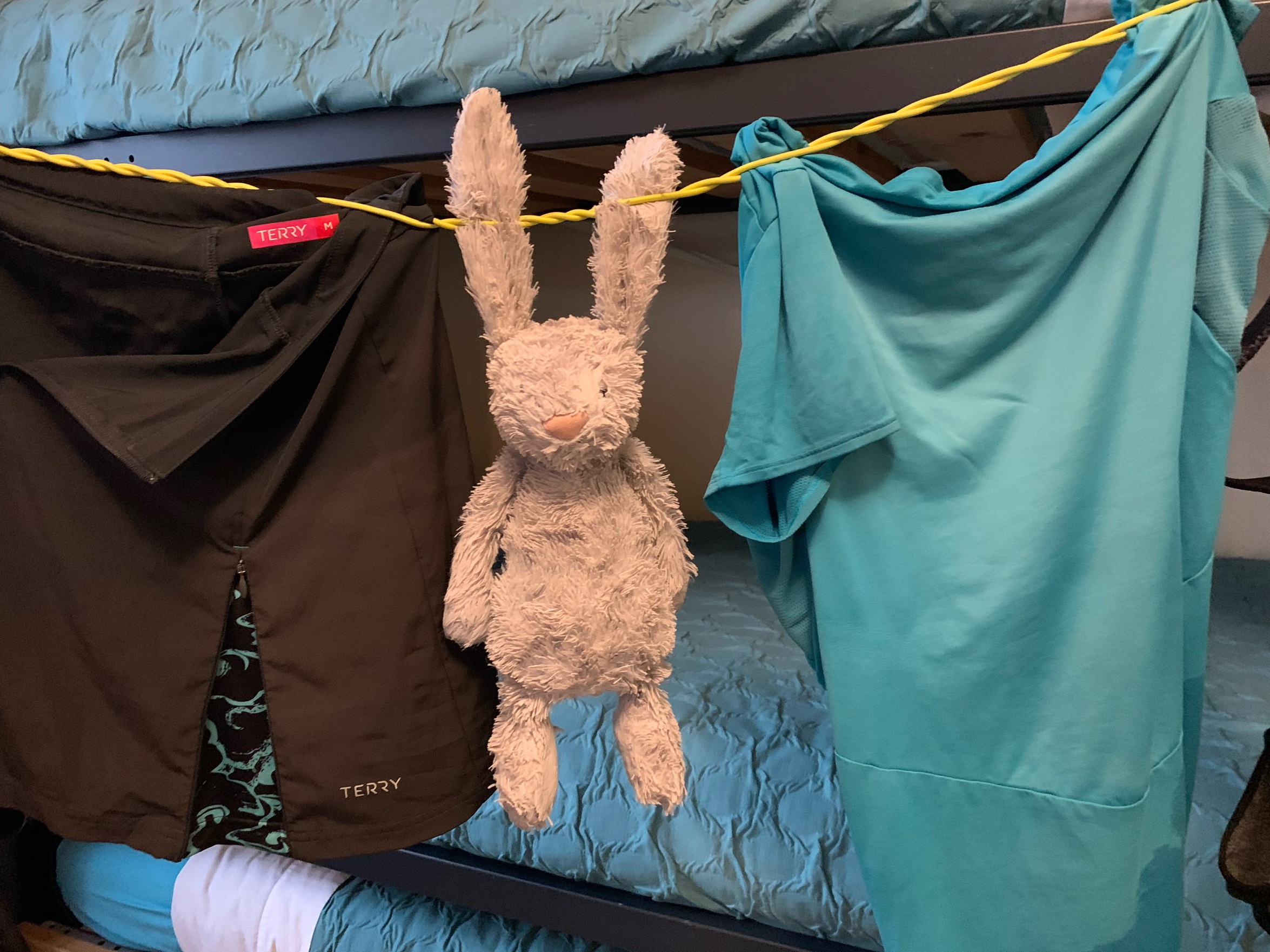
Great spot, and even better was the pizza restaurant just in back where we ate dinner. Everyone was drying wet clothes. A short walk to dinner before a well deserved sleep. Tomorrow is a big day, our longest so far, so we need to get some sleep.


We set an alarm for 6:30 and got on the road before 8:00. While in Wellington, Chris and Kelvin had figured that we could ride 75 miles that day, with almost 5500 feet of climbing. They could not have known that we would encounter 20 miles of freshly graded gravel road (slow) or 25 miles of strong headwind!


The morning was lovely, if cool. Wearing just sandals, my feet were chilly. We noticed that the sun took its time to rise, as we move south.
Per the map above, today’s route was split pretty evenly between gravel and paved. We had an abundance of climbing, but we stayed focused on making time.

The ride over the Maruia Saddle was super nice, in contrast to the Mangatapu Saddle that we’d suffered over a few days previous. The road over the saddle was well designed to keep the grade low, and the surface in good condition. We had numerous small stream crossings, which was fun. And the scenery was gorgeous and unspoiled with giant ferns and lush forest. In the lee of the wind, it was calm and quiet. That ended when we burst out of the forest into the highway, exposed to the winds, blowing steadily at about 20mph and gusty. The ride into Springs Junction was brutal. I thought of giving up and finding a spot to sleep in Springs Junction, rather than going on to Reefton. A mile from Springs Junction, an older couple saw us on the road and offered us their Warm Showers lodging, and it tempted us, but we kept on our plan to make it to Reefton, with one last 1,000 foot climb (now with a tailwind), and then basically downhill 28 miles to Reefton on paved road.


We crested the last hill and sped down the other side after adding some warmer clothing for the descent. It’s amazing how fast 20 mph feels when you have been traveling at 3 mph. We even kept the tailwind and made it to Reefton by 7PM, having ridden for over 9 hours. We made it – our longest day! We showered and got dinner of venison pie and roasted vegetable salad, but were too rushed or hungry to take pictures of the food. This was a much longer distance than any in Europe this past summer plus way more elevation gain. I think we are getting stronger!


Leave a Reply