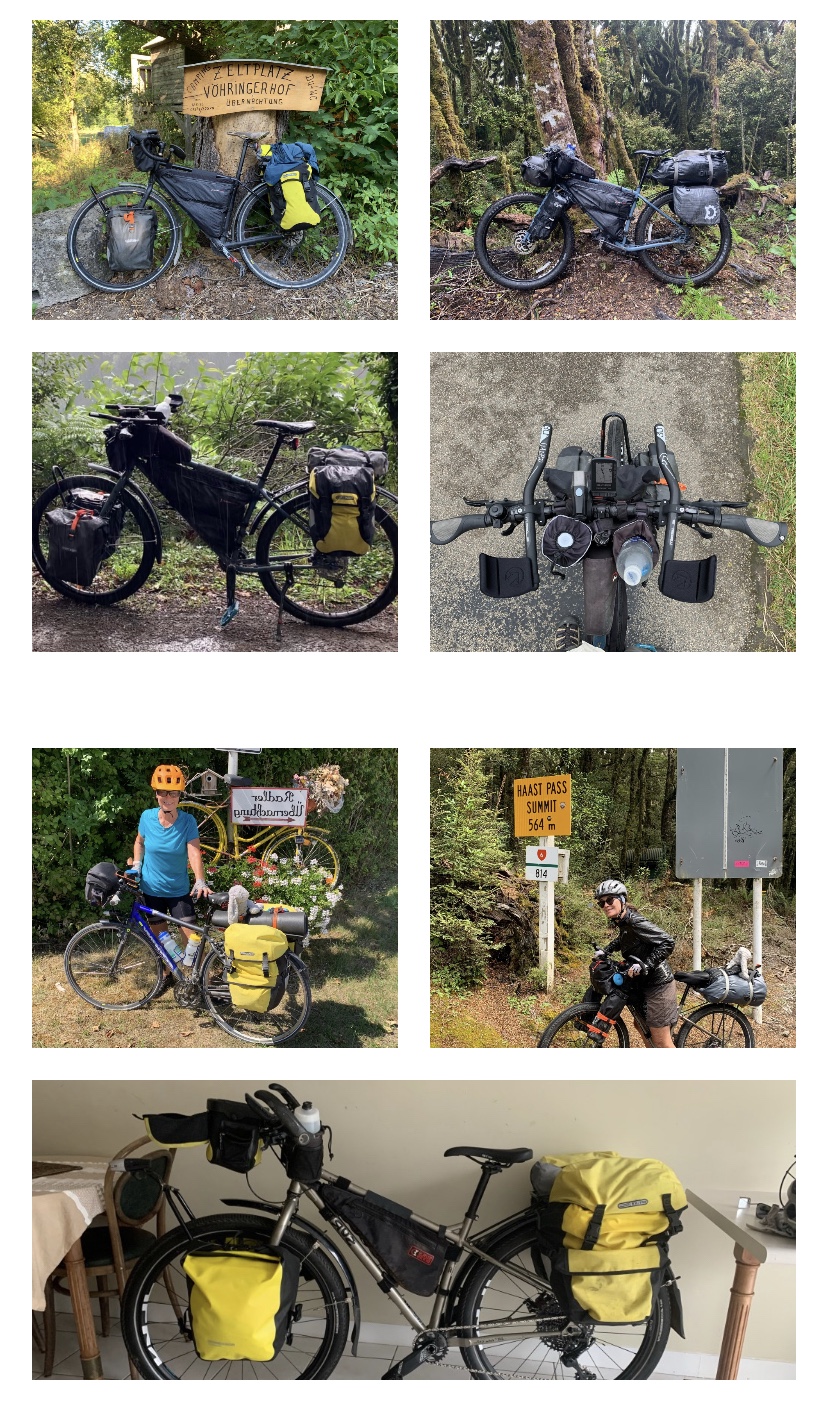
We’ve been on three chapters of this trip, including the EV6 across Europe to Slovakia, our trip to NZ, Vietnam and Cambodia, and our current trip mostly on the EV45 and EV1 from Brittany to Madrid and beyond.
For the first trip across Europe, we took our normal road touring bikes, meant to be ridden mostly on roads and paved paths, along with panniers and racks carrying our personal clothes, etc in addition to camping equipment and food. Chris’ bike was bought in 2006 just before our first bike trip in France. Mine was bought used about 6 years ago in Colorado. We used standard road touring racks and panniers that we had owned for many years.
For the NZ trip, we bought new adventure bikes, delivered in Auckland, more suited to off-road trails and rougher terrain. Adventure bikes are defined as “When your imagination outweighs your common sense – go-anywhere, do anything mountain bikes.” We brought our bikepacking bags to attach to the new bikes, that kept the weight higher in the bike. Both bikes had more connecting points for bags, and we also bought lighter weight yet stronger rear racks made of chrome moly steel. We ditched our large rear panniers (I ended up using very small, narrow panniers for plates, utensils and some daily food) and used a 40 liter dry bag that offered similar volume to our panniers to hold our clothes and other personal stuff. Panniers make the load wider and therefore more likely to catch on stuff along a trail, or on the sides of narrow bridges. I ditched my front panniers and rack, stuffing the tent and sleeping bags in a long roll that attached to the front of my handlebars. We both added two smallish (5.5 liter each) bags that mounted to our front forks, which held food, stove, and various other things. We both had a frame bag too, which for me held tools and other heavy stuff, plus we moved our water bottles to pouches suspended from our handle bars, which was easier access anyway. The goal of bikepacking bags is to get the weight higher on the bike, reducing the risk of hitting things near the ground and also to not immerse bags in water into the case of river crossings. All that planning worked out pretty well! The bikes were reasonably well balanced and the smaller volume of storage forced us to really prioritize what we brought.
When we went to Vietnam and Cambodia, we left all our camping gear and most of our cold weather gear in Australia, to be sent back to our house in Colorado by our helpful brother in law Andrew. So, we had much less to carry in Vietnam/Cambodia and therefore fewer bags.
Now being back in Europe, we took our new adventure bikes that we bought in NZ, but configured them for road touring. The new bikes allow for a bit wider tires, which we’ve appreciated quite a bit on the sometimes rough paths in Brittany. They also have longer wheelbases and stronger frames, which makes them more stable, easier to control and able to carry weight without flexing disagreeably. We added fenders for rain. Chris’ bike got lower gears than NZ (reduced size of front chainring to 28t from 32t, leading to a low gear of 1:1.71 from 1:1.5, with her 48t rear cog) but only because it was too complicated to upgrade gears in NZ. She certainly could have used the lower gears in NZ with all the extremely steep climbs. And it’s noticeable here in France that Chris is spinning more easily on climbs with the lower gears. Chris added front panniers, since her new bike has mounting screws for a front rack and her old one did not. The front panniers even out the weight distribution front/back and make the bike easier to handle. Chris’ new bike also has disc brakes which are way better, especially in wet conditions, which we have had a lot of. I added aero bars to my bike to give me a chance to take the pressure of my hands, and secondarily to give me some respite from headwinds.
The overall weight of each bike is probably about the same for all the trips, with the exception of Vietnam/Cambodia when we carried less stuff and did not camp. I carry a bit more with tools and more gear, but the goal is to ride about the same speed and arrive where we are going with the same amount of energy left.


This trip, we both have 2.4 inch (61mm) wide tires with a smooth stripe in the middle for maximum rolling ease on smooth roads, and some small knobs on the sides for looser terrain. In the picture below, you can see my 2.8 inch tire on the right I used in NZ vs the ones we are using in Europe this trip.

Leave a Reply