Chris has been in England for about a week now, with me staying here at Martin’s house in Ivanka to take care of Doris. For clarification, Ivanka is a suburb of Bratislava, with the full name of Ivanka pri Dunaji (Ivanka near the Danube). In the US, Ivanka is a name that is loaded with recent meaning, but that Ivanka and the town we are staying in are not related!
Being here by myself with Doris the dog (who, by the way, knows no Slovak!) makes me more dependent on people knowing English. Sometimes cashiers ask me questions that I don’t understand, and it’s nice to chat with people on the trail or wherever, so I always ask if people speak English. Maybe half do…
I use Google Translate in stores to make sure I’m buying fruit juice, not vinegar and figuring out which package is parsley vs cilantro. And many more things too!
When Chris and I are here together, we can do things together, and communicate in our first language which is English. Of course, there are some minor differences between the proper Queen’s English and my heathen American English, but we cope. 🙂
Chris knows more of Slovak than I do, since she lived in Nitra, Slovakia, 30 years ago teaching English. Nitra is about 50 miles from Martin’s house by car, and so we hope to go visit in the next couple days to see how much it’s changed in the intervening decades. We hear that it’s changed a lot!
I have my cheat sheet of saved phrases on my phone, but the wrong word often jumps from my mouth in the heat of trying to say something. When I mean to say “Thank you”, I might say ‘Please.” I see the puzzled looks. Then I want to say “I’m Sorry”, but instead I blurt out “Hello/Good day”. I’m pretty sure everyone thinks I’m crazy, but maybe not since my pronunciation might be so bad that they might think I’m simply speaking in some other language. I hope it’s not Russian.

Since we’re here for a pretty short time, it seems kind of pointless to try to learn more than the most basic Slovak. Learning Slovak is hard for native English speakers. Here are some (not all) of the reasons:
– Syntax can be done in more than one way, which is confusing. Worse than English, for sure.
– There are all these crazy accents above letters, affecting pronunciation! Letters like ľ, š, č, ť, ž, ý, á, í, é, ú, ä, ň, ô, dž, ch, can give you a headache, especially when in some cases you don’t write the “ ˇ ” sign above some letters, although it sounds like you should.
– Slovak, like most Slavic languages and Latin, is an inflected language, meaning that the endings (and sometimes also the stems) of most words (nouns, adjectives, pronouns and numerals) change depending on the given combination of the grammatical gender, the grammatical number and the grammatical case of the particular word in the particular sentence. And there are 7 grammatical cases in Slovak. English has 1 or 2, depending on whose counting.
– Because the accents change the pronunciation of the letter/word, this can change the whole meaning of a word/sentence (examples in English where long and short consonants affect meaning are the words “ship” and “sheep” or “fill” and “feel”)..Slovak words that illustrate this are “vyr” and “výr” or “vila” and “víla”
– If you are brave, try saying “Strč prst skrz krk” which is actually the longest sentence without any vowels that makes sense in Slovak language (it means “put a finger through your throat”)

Speaking of putting a finger through your throat, the above is the “National Dish of Slovakia”, per Eva, a long time friend of Martin that we have met. It’s fried cheese and french fries, guaranteed to make your hair shiny for at least a month. It is typically served with tartar sauce. The above picture is my plate. Was it good? Well…I can say that I’ve never had better fried cheese and french fries, so let’s leave it at that.
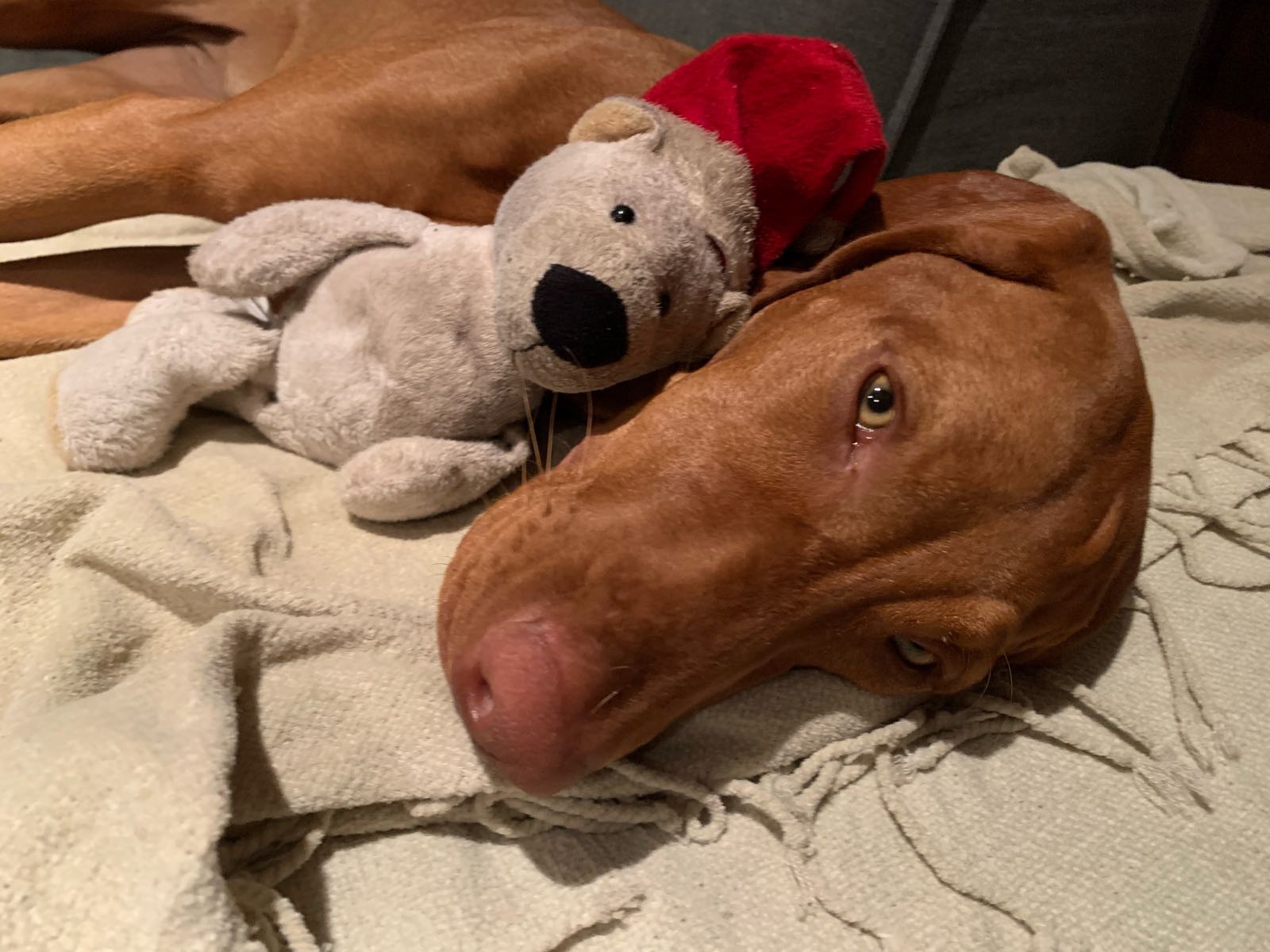
And finally, here’s some pictures of Doris. She’s making some slow progress at obeying commands and not jumping at small children and bicycles. Every day is an adventure, for sure.


Leave a Reply